• On the female body as public space
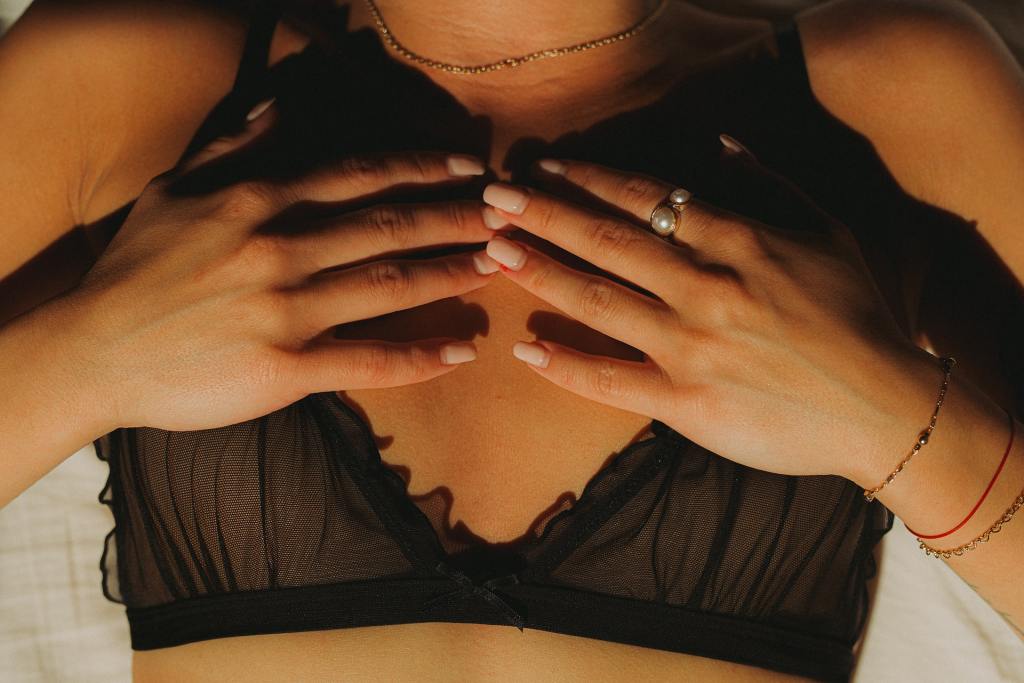
    Photo by Dainis Graveris on Unsplash

    *When referring to the female body throughout this text, and unless expressly noted, the author includes all female-presenting bodies, not only those assigned as female at birth.

    Opposing women’s right to control our own bodies is always the first step in every authoritarian regime.

    Gloria Steinem.

    People have felt the need to comment on my body without being prompted ever since I have a memory. I gained weight, says my mother; my ass looks great in those pants, say random men on the street; that dress is showing too much cleavage, says a friend; I’m “unfuckable”, say anonymous people online; I would look better if I put some makeup on, say old ladies at the bank. Even my ex has thoughts about me having cut my hair short that nobody asked him about. The thing is that I know why: female bodies seem to be up for discussion by and from anyone because they are treated as public property.

    The notion that us walking down the street somehow “invites” these comments stems from the idea that female bodies are public spaces, perform a public service, and belong to society as a whole, unlike male bodies, which are private and not a battleground for public discourse. The so-called “male gaze” is not only that, it’s the “male prodding” and the “male poking” and the “male choice” about what I can and cannot do with my body. It’s the male gynecologist who berated me about my age and not having had kids yet as if I was a small child and not a paying customer; it’s the policeman who stopped me in the street and told me I shouldn’t be walking around with a skirt so short as if he was doing me a favor, it’s the cab driver who felt the need to tell me that women with tattoos were less worthy of a man’s respect.

    After the derogation of Roe v. Wade by the United States’ Supreme Court, we all seem to be thinking about this in some way. The notions of bodily integrity and bodily autonomy, already flimsy in the US, seem to be vanishing after abortion is no longer protected at the federal level. But the thing is that predicating sexual and reproductive rights, and in general, rights about our own bodies, over the right to privacy is problematic as the barrier between what’s private and what’s public continues to be erased and women’s bodies are put in the public side of the equation.

    Even among the people who are now questioning or plainly refusing this derogation, there seems to be little discussion about why is it so difficult, not only in the US but everywhere, to get a long-term or permanent contraceptive solution, why doctors deny a woman who wants to get a sterilization because she’s under 30, or she doesn’t have a partner, or she does have a partner but he hasn’t expressed his consent, or she hasn’t had any kids yet and her desire to not have them means nothing (“you will change your mind later”, we are told, because apparently, these doctors know more than ourselves about our own minds). Women everywhere keep being treated as if we were only worth three-quarters of a full person: we get asked for the opinion of our non-existent husbands on a weekly basis, every time we have to make decisions about our health or our money, and we still feel the need to make up a name for that non-existent husband when a random man wants to hit on us and won’t quit, because a non-existent man is something more worthy of respect in his eyes than a real, existing woman who is telling him to fuck off.

    For Latinas, this notion of not owning our bodies is part of how we are raised (I got a tattoo, in part, to claim ownership over my own body, and yet I still get berated by my mom, at age 37, every time she remembers it, or when I cut my hair, or when I gain some weight). This is, in large part, because our appearance is a commodity, and thus, it’s part of our family’s patrimony, because in Latino culture we’re still endowed with the task of helping our family move up the social ranks and this is done by means of trading our beauty in the marriage market. Unsaid as this is, it is something that we carry inside us as a sort of evident truth that even the most deconstructed of women will recognize the minute we watch a pageant or are told by our auntie we should lose some weight or we’ll never find a husband.

    In current culture, women’s bodies are spaces of public debate ―however I choose to present myself, whatever I choose to wear, I must accept that I’m inviting people to comment on it― but also as spaces that perform a public service ―should we choose not to have children, we must accept this will come with years of uninvited comments about our wrongness in refusing to fulfill our sacred purpose in society; should we choose to have them, and our bodies automatically become a space not only for people to watch and discuss, but also to touch without consent. 

    Reclaiming one’s own body is seen as disruptive – women enjoying their bodies is disruptive, women’s pleasure is taboo, and in general, women are not supposed to express needing, wanting or enjoying sex ―sex is supposed to be something we do for men, in order to fulfill their needs. The idea of enthusiastic consent seems too much because men are not socialized to expect women to enjoy sex enthusiastically, and therefore the bar appears to be too high when demanded that they only have sex with women who are excited to be there. It should not be a surprise, then, that pregnancy is seen as punishment for having felt pleasure ―the only acceptable exception for abortion, and then, only theoretically, is rape or peril to the mother’s life, and even then they would have to be proved to a degree where it would likely be too late: even then, you would have to convince men to grant you a special pardon over your sins, over the original sin of womanhood. Abortion is seen as scandalous because it is a woman attempting to avoid her rightful punishment for having enjoyed sex without the intent of reproduction. 

    Moreover, the sexualization of women’s bodies is completely normal and accepted when done by men through means of popular culture, advertising, or mere catcalling. But when a woman chooses to sexualize herself ―by taking sexy selfies, posting “thirst-traps”, or creating an OnlyFans account― she will be accused of narcissism, vanity, banality, and “whoreness”. The most innocent selfie will have a comment telling the person that they are “trying too hard”, basically shaming them for attempting to like themselves, even in a culture that is constantly shouting at us to “love ourselves”. 

    Like all other attempts at claiming our own bodies back, the selfie is the drawing of a line around how we define our identities. When we step back and allow the world to claim the land that is our bodies, we are being stripped away from our ability to define ourselves in the world, which is just one step away from living without the freedom to determine who we are.

  • An incomplete inventory of the things I lost in the suitcase that Lufthansa won’t give back
    Photo by Sun Lingyan on Unsplash

    My favorite dress, not that one, the one that you remember so well ―that one survived for no reason in my overflow bag.

    A bottle of impossible glowTM that Laura made me buy and that now I don’t know how to live without.

    A couple of books I took for the trip and never got to read.

    A few campaign flyers and a dammit doll that got whacked so much back in DC against so many tables ―so much frustration, you wouldn’t imagine.

    My favorite liquid black eyeliner, the one I wear most days. Almost all my favorite makeup, really, that Arianna picked from my dresser for me to wear during the trip.

    Three weeks’ worth of medication that I seem to be doing perfectly fine without, even though I won’t leave that to random chance.

    A bunch of receipts that the finance team will ask me about later in the month.

    A handful of memories of nights gone by and a stash of dirty laundry I never got to wash.

    A bathing suit that never got to fully dry from that last day in Paris, and that must be ruined by now.

    A jar of Laneige’s lip mask that made my lips so impossibly soft I thought it was witchcraft.

    Stickers, so many stickers. World Bank reports I already read in PDF. All those notes I took and didn’t back up. 

    The naïve idea that it would be all perfectly fine after crashing against your smile and shattering into a million pieces.

    My favorite trench coat. Things I forgot about, I’m sure, and will be randomly remembering for weeks to come. Things I’m trying so hard to forget about.

    Photo by Sun Lingyan on Unsplash

  • Unbelonging
    Photo by Giorgio Trovato on Unsplash

    I think I’m more at home in transience than in places, in liminal spaces like airports and hotels, in traveling and unbeing than in the rooted notion of a country with borders and tags and specific requirements. I’m most at home at home, in my apartment that is almost a non-place in itself, made out of a strange collection of books and objects that could be found in many places, right in the margins of where Chile becomes the Venezuela I carry with me everywhere, a country that once existed and is now no more —replaced by a new place that carries the same name but that I don’t know anymore, a place where I don’t recognize myself as belonging—, in my apartment two blocks away from La Moneda but that once you cross the door is all arepas and Desorden Público, with me and my American YouTube channels and my Taylor Swift always streaming and my Chilean cat, rescued from the streets, so anxious about space and territory, so needy with her constant requirements of love being reaffirmed, just like me.

    I think I might now be more at home in English than in Spanish, and that maybe it’s because Spanish runs too close to my wounded heart, touches places that still hurt so much, opens scars that are still not fully healed and that might never be. English is not mine and therefore it feels safer, because by now I’m used to unbelonging, to never fully fitting in, to borrowed places and stories and words and feelings that I put on like an orphaned lamb, maybe trying to disguise myself in order to not attract anyone’s attention, trying to camouflage to survive.

    For many of the things I still need to tell, I have yet to find the words in Spanish. To tell the story of the time my home -not my physical home, my notion of home- was wrecked by men with automatic rifles who raided my building and took my neighbors; to tell the story of the time my home was pulled apart by the man who I thought would be my partner for the rest of my life; to tell the story of my bloody and troubled relationship with my own body, of my obsession with the relationship between the body and the self, of the many things my fiction has wanted to say and has come short over and over. But there is so much unsaid in what has been lent and borrowed between me and the world once and again: so many stolen words from foreign languages, from songs and poems, from the words that my friends have lent me to describe themselves and myself, the myriad of ways in which our experiences of the world cross over boundaries that suddenly disappear when we realize that their “habibi” is my “miamor” and that an empanada is an empanada is an empanada.

    I think I’m most at home where I don’t belong, which by now might mean that I’m most at home anywhere, because I don’t think I will ever belong again in any place, because once you’re an immigrant you can never cease being an immigrant, even if you go back, because as Odysseus, we can never truly return home not only because home has changed, but because we ourselves have changed and are now “part of all we have met”.

  • Constellations
    Photo by Michał Mancewicz on Unsplash

    She has had her heart broken one too many times, but she thinks everyone else has too. She likes making up stories about the people she sees in the subway, walking down the streets, across the park: every one a glimmering heap of broken glass, all shimmer and reflection and piercing edges of beauty and danger. So she carries her heart, the broken pieces that still haven’t gone missing, inside her, holds them close, always prepared to get it broken once again.

    She sees men -people- like cities: her first true love was a man she saw as Buenos Aires, a turbulent love, wild and ever-changing, erratic and intense. Her second boyfriend was Santiago: hot and cold, a love that came in waves, that made her feel like the ground was always moving under her feet. But as for him, she thinks he’s her New York: the place that opens up her heart like a wild wind, the place that forces her eyes up to the sky. She feels that she belongs to him, but he belongs to someone else. 

    She sees into him much deeper than everyone else. Somehow, she sees both the fire and the sky in his blue eyes, both the yearning for something magic, uncontrollable, ferocious that still hasn’t arrived, and the desire to settle down, the thirst for a calm that slips between his fingers every time he finds it. She thinks she’s both: the wilderness and the calm, because she thinks she has a river running inside her, sometimes fast, fierce and dangerous, and others still, nurturing, peaceful.

    She likes the way her name rolls out of his lips, like an astronomer discovering a star, once and again, for the first time. The way his voice says her name makes her feel brand new, like coming out for air from the depths of the ocean. She doesn’t know how to swim, and yet somehow she always walks right into the deep end. She would like to be happy, yes, but if a choice needs to be made she will always prefer to live an interesting life. That’s how she has had her heart broken so many times. She would walk straight up to him, hand him over her heart, and tell him: here, break it into a million pieces. She would do that if only that was a choice available to her.

    Every night her skin wakes up like it was made out of constellations; stars turning on one after the other like a string of fairy lights all over her body. Somehow she feels that he knows this; that he can feel her body calling him from across the dark of the night, that he knows that his fingertips can wake up the stories buried deep within her since centuries ago. Yet, it’s his choice to leave them in their long slumber, waiting for the sky to flip its cards again.

  • ~ looking for ~

    now that you’re gone

    people ask what i’m looking in a man

    but the fact is i’m not looking anymore

    i do want someone

    to hold my naked body in the cold nights

    under the blankets, the way you stopped doing

    many years ago

    but i’m not looking for them

    i turn up the heater and curl up

    i close my eyes to not look

    i do want someone 

    to laugh at my bad jokes the way you never did

    you never found me funny, all these years

    you found me cute or tender or even laughable

    but never funny

    i tell myself these jokes

    and close my eyes 

    to listen to other people laughing

    when i don’t care

    i do want someone

    to hold my hand when walking down the street

    the way you stopped doing years ago

    there was always a reason

    sweaty hands, carrying bags, was just awkward

    and i walked with my hands inside my pockets

    the same way i do now

    but i’m not looking for your hand anymore

    i’m not looking for a man –or for a woman, for that matter–

    but oh would it be nice

    to have these things

    that only after you left i could realize

    i had lost so long ago

    i wasn’t looking for them anymore. 

    ~ pd ~

    this position is open only to people

    who care deeply about life

    only to people who don’t go through life 

    with their eyes closed

    but with their skin awake, their tongue held out

    to taste and feel and see and hear 

    every little thing

    someone who savors every new bite

    every new lick and sip and sight of this life

    someone who loves to wander and discover

    and be mesmerized by the world around them

    this position is open only to people with hands made to create

    art or music or food or pleasure

    people who care deeply about others’ wellbeing

    people who believe strongly in the rule of law

    but are willing to help me overthrow things if need be

    people who have in their hearts the love 

    to hold a fortress around their own

    and the fire to burn what needs to be burnt down

    someone with whom i can share

     my favorite words

    –llovizna, guarapo, bululú–

    even if i have to explain them what they mean

    someone who loves to travel 

    without caring for the destination

    because the world holds infinite possibilities

    and not enough life to live them all

    if you’re willing to go through life

    like if life was a dress rehearsal 

    for something else

    please don’t apply

    we’re not welcoming dilettantes at this time

    we need commitment 

    not to me, but to life

    and its many, mysterious possibilities 

    this position is open only to people

    who make love like the world is about to end

    because it might. 

    ~ promise ~

    this is my promise to you

    i will always look into the bottom of your eyes

    to hear not only what you’re saying but also what you’re not

    i will hold your hand in crowded rooms

    below the table at dinner meetings

    and when walking down the street to get some coffee

    this is my promise to you

    my voice will remain soft even when telling you you’ve messed up

    you’ll always have the kindness and the patience and the space

    your humanity deserves

    and i’ll be on your team

    even when we’re losing the game

    this is my promise to you

    i will celebrate your accomplishments and your failures

    because trying merits celebration

    and when you feel like not trying for a while

    we will build a pillow fort and hide inside it

    together

    this is my promise to you

    i will keep our house warm and our wine cool

    and when we both come home after a long day

    we will find peace and laughter and home

    we will laugh about what went wrong

    we will cry together if need be

    this is my promise to you

    the love i haven’t met yet.

    Download these as a PDF here.

  • Terrible thoughts
    Photo by Nijwam Swargiary on Unsplash

    When crossing the street on an intersection that I walk every day: to be run over by that bus that’s rapidly approaching its stop; to die instantly. 

    When making breakfast at home: to put my hand over the hot griddle; to feel the raging burn coursing through my skin, melting it away. 

    When petting my cat on the balcony, running my fingers through her fur, so soft: to extend my hands over the rail, to open my hands, to let her fall. 

    When sitting at the bookstore’s café, reading the novel my creative writing teacher wrote while he was my teacher: to not see through the corner of my eye someone coming in with a gun, opening fire; my bloodied body laying on the floor next to the red cover of the book my creative writing teacher wrote while he was my teacher. 

    To light a fire, to let it burn. To grab a knife, to let it cut. To take the pills, to leave none. 

    When looking into the blue of your eyes, sweet but indifferent: to let myself fall into the deep end, and to sink, and to drift, and to drown, and to die. 

  • The art of losing and getting lost

    The way I see it, life is an exercise in losing. You go around leaving pieces of yourself behind, things you have lost while moving places, while leaving relationships, while changing jobs, fragments you will never recover because going back is impossible. It is my fundamental belief that a person is made of the pieces they have as much as from the pieces they have lost, that you can very well find the contour of the person I am by tracing the spaces left behind by all of the things that I have lost: a home, a country, a man I loved, the ability to trust with childlike carefreeness, the ability to rely on a functioning world instead of scurrying and stockpiling like a child of war.

    I also believe that getting lost is, in itself, a way of losing: of losing the ties that chain you to your sense of self in ways that are external, artificial, sometimes even arbitrary. In my favorite book of all times, Rebecca Solnit’s “A field guide to getting lost”, she quotes Virginia Woolf on the dissolution of identity that takes place when one is traveling. Solnit says:

    “For Woolf, getting lost was not a matter of geography so much as identity, a passionate desire, even an urgent need, to become no one and anyone, to shake off the shackles that remind you who you are, who others think you are”.

    Both the feeling and the concept are something that has always mesmerized me: being at an airport, or in a far away city, where nobody knows who you are and thus cannot hold you to the idea that others have about who you should be, even to the idea that you yourself have about it. The disappearance of those constraints, of those markers and references, and how one can lose things temporarily -such as identity- only to recover them when coming back. But who are we in that slice of time? What is left after we lose every external reference, after we “shake off the shackles”?

    Before pandemic times, I used to travel a lot for work, maybe four or five times a year. I loved traveling, even though -or precisely because- the way I traveled was all about airports, hotels and conference rooms. These, to me, are all nonplaces, in the sense coined by Marc Augé: “anthropological spaces of transience where human beings remain anonymous, and that do not hold enough significance to be regarded as “places” in their anthropological definition”. Maybe in those conference rooms I would meet my friends and colleagues, go up on stage, say some things that I might consider somewhat interesting, but right after the conference was over, that room would lose all sense of meaning to me. As for hotel rooms and airports, they are the perfect places for someone like me, always looking for the dissolution of identity, for the disidentification of my own consciousness.

    This is probably a good place in this text to introduce a caveat: I live with bipolar disorder type II, dominated by periods of depression over periods of mania. For many people like me, the notion of dissolving one’s own conscience is tempting because it might mean the end of suffering. For some, experimenting with drugs might make sense, while for others, Buddhism might offer some answers, but that’s not the direction I’m going with this. Solnit also speaks about the desire for what Buddhists call “unbeing”, and says “it’s not about being lost but about trying to lose yourself”.

    The desire to lose yourself might be so strong that it leads you -in the words of Solnit- “to walk into a river with pockets full of rocks”.


    A few months ago, my partner of seventeen years decided to leave me. There is no need to go into further detail about that; it was one of those situations where there’s really nobody to blame. However, and even though I have a very strong personality -some might even say too strong-, his absence after almost two decades caused a sort of dissolution of identity that was hard to reckon with. What are things that I really like and what are things that I have become used to after being with someone else for so long? What are things that I like, but I have left aside to make more space for this other person? What about the decisions I made because we were a couple, like moving to a specific country or city? Do I still want those things? 

    It has been hard to disentangle the parts of such a long relationship that were, nevertheless, mine to keep. Similar to separating property after a divorce, there are entire vastnesses of life, spaces, logics, habits, routines, that you need to look in the face and interpellate: are you mine? were you ever mine?

    Last Friday I visited a sensory deprivation tank. This is a place where you get into what seems like a very big bathtub, filled with water that contains an amount of Epsom salt that allows it to create a gravity of around 1.24, which allows the person to float effortlessly, in a pitch black, soundproof environment. To make it short, you’re supposed to not perceive any external stimuli through any sense while being in there. As I said to my therapist, whom I consulted beforehand, this seemed to me the closest experience to non-existence I could ever go through in a safe manner. And it was it, but it also was not it at all, because the core of what is you keeps existing, in the same way there’s only so much that an airport or a hotel can dissolve of your identity.

    When we leave, we may think we’re taking everything with us, leaving nothing behind. But we can never take the space we leave where we used to be, the space where we are no longer. I just spent a ton of money remodeling my rented apartment and now I’m thinking of moving away because my ex-boyfriend’s absence is strewn all over the place and I cannot pick it up the way I pick up the dirty glasses I leave behind.

    Eventually, we end up learning that there are things that have a vocation for being lost; things that are in our lives only meaning to disappear eventually. As Elizabeth Bishop says, in her marvelous poem “One Art”,

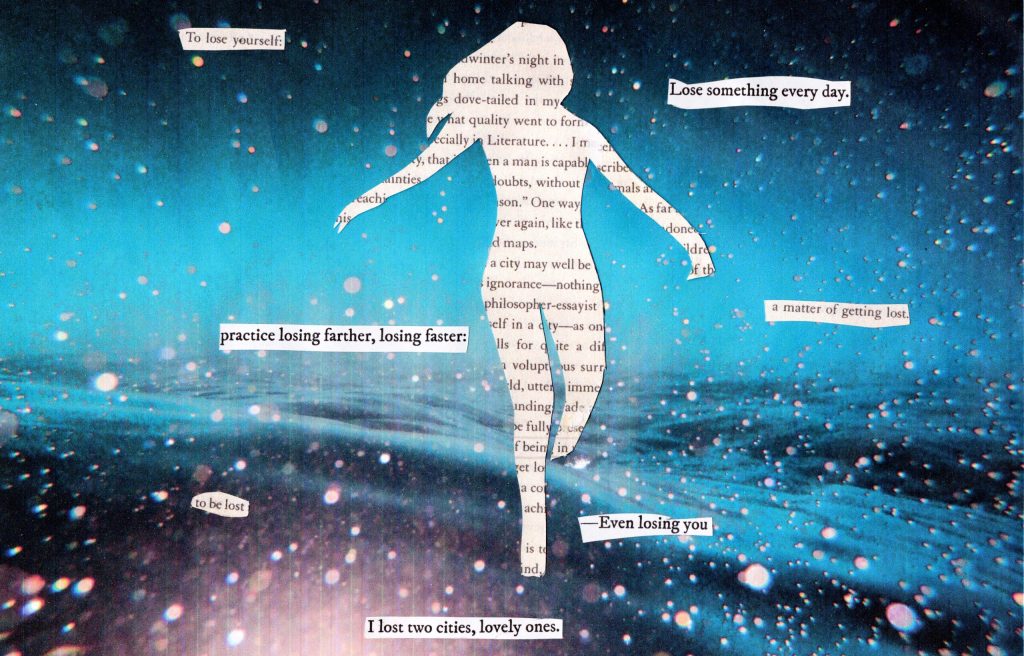
    Lose something every day. Accept the fluster
    of lost door keys, the hour badly spent.
    The art of losing isn’t hard to master.
    
    Then practice losing farther, losing faster:
    places, and names, and where it was you meant
    to travel. None of these will bring disaster.

    The practice of losing, I believe, is not only an exercise in adulthood but an exercise in mortality. One day we will have lost everything and everyone will have lost us, and inevitably, we will have left our absence strewn about, unpickable. As an immigrant, I also believe that migration is the mastering of the art of losing and getting lost. Flavors, accents, sounds, books, friends, we eventually learn the transience of it all, we eventually accept that nothing is ever in our lives for good.

    I lost two cities, lovely ones. And, vaster, 
    some realms I owned, two rivers, a continent. 
    I miss them, but it wasn’t a disaster.

    When moving to Chile originally, I got asked a lot if Chile was my “forever place”. This is a concept I didn’t grasp back then and now I grasp it even less, if possible. Nothing is forever, there’s only for now. Right this second, as I write these lines, there’s nothing else I can assert with such clarity and certainty as this.

    —Even losing you (the joking voice, a gesture
    I love) I shan’t have lied. It’s evident 
    the art of losing’s not too hard to master 
    though it may look like (Write it!) like disaster.